Teaching

Textbooks, lecture notes, and recent course pages.

Textbooks

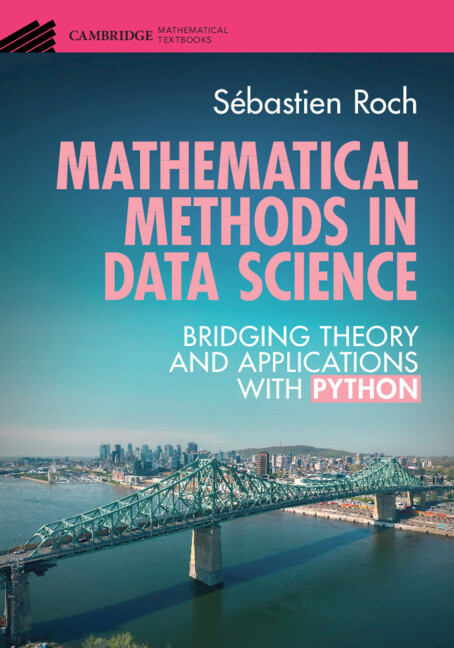
Mathematical Methods in Data Science cover
Mathematical Methods in Data Science: Bridging Theory and Applications with Python

Cambridge University Press, 2025.

From the publisher: "[This book] covers essential topics in linear algebra, calculus and optimization, and probability and statistics, demonstrating their relevance in the context of data analysis. Key application topics include clustering, regression, classification, dimensionality reduction, network analysis, and neural networks. What sets this text apart is its focus on hands-on learning. Each chapter combines mathematical insights with practical examples, using Python to implement algorithms and solve problems. Self-assessment quizzes, warm-up exercises and theoretical problems foster both mathematical understanding and computational skills."
Modern Discrete Probability cover
Modern Discrete Probability: An Essential Toolkit

Cambridge University Press, 2024.

From the publisher: "Providing a graduate-level introduction to discrete probability and its applications, this book develops a toolkit of essential techniques for analysing stochastic processes on graphs, other random discrete structures, and algorithms. Topics covered include the first and second moment methods, concentration inequalities, coupling and stochastic domination, martingales and potential theory, spectral methods, and branching processes. Each chapter expands on a fundamental technique, outlining common uses and showing them in action on simple examples and more substantial classical results."

Lecture Notes

Current Courses

Past Courses at UW-Madison

Past Courses at UCLA

Spring 2012 MATH 32B: Calculus of Several VariablesUndergraduate - UCLA

Prerequisite: course 31B and 32A. Introduction to integral calculus of several variables, line and surface integrals.

Spring 2012 MATH 285J: Applied Probability -- An IntroductionGraduate - UCLA

Prerequisite: undergraduate probability course will be useful. Overview of basic probability: events, random variables, generating functions, basic limit laws, simulation. Introduction to Markov processes: Markov chains, Poisson processes, branching processes, continuous-time Markov processes, diffusion processes and numerical methods.

Winter 2012 MATH 32B: Calculus of Several VariablesUndergraduate - UCLA

Prerequisite: course 31B and 32A. Introduction to integral calculus of several variables, line and surface integrals.

Winter 2012 MATH 275B: Probability TheoryGraduate - UCLA

Course page

Prerequisite: course 245A or 265A. Connection between probability theory and real analysis. Weak and strong laws of large numbers, central limit theorem, conditioning, ergodic theory, martingale theory.

Spring 2011 MATH 182: AlgorithmsUndergraduate - UCLA

Prerequisite: course 3C or 32A. Graphs, greedy algorithms, divide and conquer algorithms, dynamic programming, network flow. Emphasis on designing efficient algorithms useful in diverse areas such as bioinformatics and allocation of resources.

Winter 2011 MATH 275B: Probability TheoryGraduate - UCLA

Prerequisite: course 245A or 265A. Connection between probability theory and real analysis. Weak and strong laws of large numbers, central limit theorem, conditioning, ergodic theory, martingale theory.

Fall 2010 MATH 275A: Probability TheoryGraduate - UCLA

Prerequisite: course 245A or 265A. Connection between probability theory and real analysis. Weak and strong laws of large numbers, central limit theorem, conditioning, ergodic theory, martingale theory.

Spring 2010 MATH 285K: Topics in Probability: Stochastic Processes in Evolution and GeneticsGraduate - UCLA

Prerequisite: no biology background is required; a graduate course in stochastic processes will be useful. Rigorous mathematical analysis of probabilistic and combinatorial structures arising from biology, mostly in the study of evolution and genetics.

Winter 2010 MATH 275B: Probability TheoryGraduate - UCLA

Prerequisite: course 245A or 265A. Connection between probability theory and real analysis. Weak and strong laws of large numbers, central limit theorem, conditioning, ergodic theory, martingale theory.