I work in probability, data science, mathematical biology, networks, and phylogenetics, drawing on statistics and theoretical computer science. More details on my research interests and publications can be found here.
PanelI will take part in a SIAM(Pie) Seminar P-AI panel on AI in mathematical research, graduate education, and careers at UW-Madison on October 2.
GrantI am a co-PI on a new NSF Research Training Groups award, Mathematics & AI Synergies (MAIS): Algebra and Applications, led by Jose Rodriguez with Jordan Ellenberg and Qin Li. More details here.
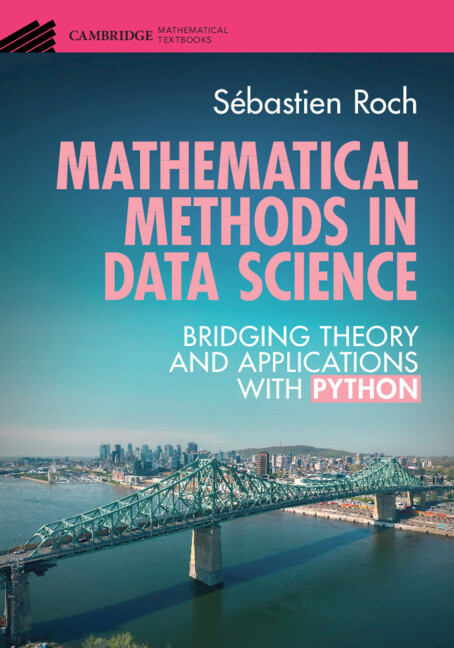
From the publisher: "[This book] covers essential topics in linear algebra, calculus and optimization, and probability and statistics, demonstrating their relevance in the context of data analysis. Key application topics include clustering, regression, classification, dimensionality reduction, network analysis, and neural networks. What sets this text apart is its focus on hands-on learning. Each chapter combines mathematical insights with practical examples, using Python to implement algorithms and solve problems. Self-assessment quizzes, warm-up exercises and theoretical problems foster both mathematical understanding and computational skills."
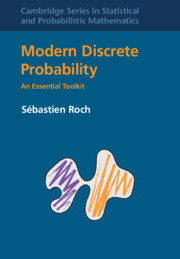
From the publisher: "Providing a graduate-level introduction to discrete probability and its applications, this book develops a toolkit of essential techniques for analysing stochastic processes on graphs, other random discrete structures, and algorithms. Topics covered include the first and second moment methods, concentration inequalities, coupling and stochastic domination, martingales and potential theory, spectral methods, and branching processes. Each chapter expands on a fundamental technique, outlining common uses and showing them in action on simple examples and more substantial classical results."
We consider the branch-length estimation problem on a bifurcating tree: a character evolves along the edges of a binary tree according to a two-state symmetric Markov process, and we seek to recover the edge transition probabilities from repeated observations at the leaves. This problem arises in phylogenetics, and is related to latent tree graphical model inference. In general, the log-likelihood function is non-concave and may admit many critical points. Nevertheless, simple coordinate maximization has been known to perform well in practice, defying the complexity of the likelihood landscape. In this work, we provide the first theoretical guarantee as to why this might be the case.
Maximum likelihood estimation is among the most widely-used methods for inferring phylogenetic trees from sequence data. This paper solves the problem of computing solutions to the maximum likelihood problem for 3-leaf trees under the 2-state symmetric mutation model. The main result is a closed-form solution to the maximum likelihood problem for unrooted 3-leaf trees, given generic data.
Ancestral sequence reconstruction is a key task in computational biology. This work establishes a formal connection to multiple sequence alignment and shows that perfect pairwise sequence alignment with high probability is possible in principle at arbitrary large evolutionary distances, provided the phylogeny is known and dense enough.
We consider species tree estimation under a standard stochastic model of gene tree evolution that incorporates incomplete lineage sorting and gene duplication and loss. Through a probabilistic analysis of the model, we derive sample complexity bounds for widely used quartet-based inference methods.
Phylogenomics is a common step in many biological studies. This paper addresses the challenge of estimating species trees under gene duplication and loss, proving identifiability under a standard stochastic model and statistical consistency for the ASTRAL-multi algorithm under this model.
Respondent-driven sampling reaches participants via peer referral. Under a Markov model for RDS, previous research has shown that if the typical participant refers too many contacts, estimator variance does not decay like O(1/n). This paper shows that generalized least squares can effectively reduce the variance of RDS estimates.