Welcome to my homepage
I am an Associate Professor at the Department of Mathematics, University of Wisconsin-Madison. I am also a faculty affiliate of the Institute for Foundations of Data Science (IFDS), a multi-University TRIPODS Phase II Initiative.
I am also the Secretary of the Society for Industrial and Applied Mathematics Mathematics of Planet Earth (SIAM MPE) and a member of a US CLIVAR Working Group. I also lead the MPE Studio with some of my group members, an open platform we are developing for exploring applied mathematics through interactive experiments, visual stories, and Earth-system examples. A significant part of my broader professional activities focuses on building stronger connections between applied mathematics, data science, and geoscience through research, education, scientific communication, outreach, and community-building efforts. These activities include organizing interdisciplinary sessions, panels, and other programs at major mathematics and geoscience meetings, as well as developing systematic online video series, short courses, public lectures, and other educational resources. I also work at the interface of applied mathematics and material science.
I am an editor of Physica D: Nonlinear Phenomena (Elsevier) and Nonlinear Processes in Geophysics (EGU).
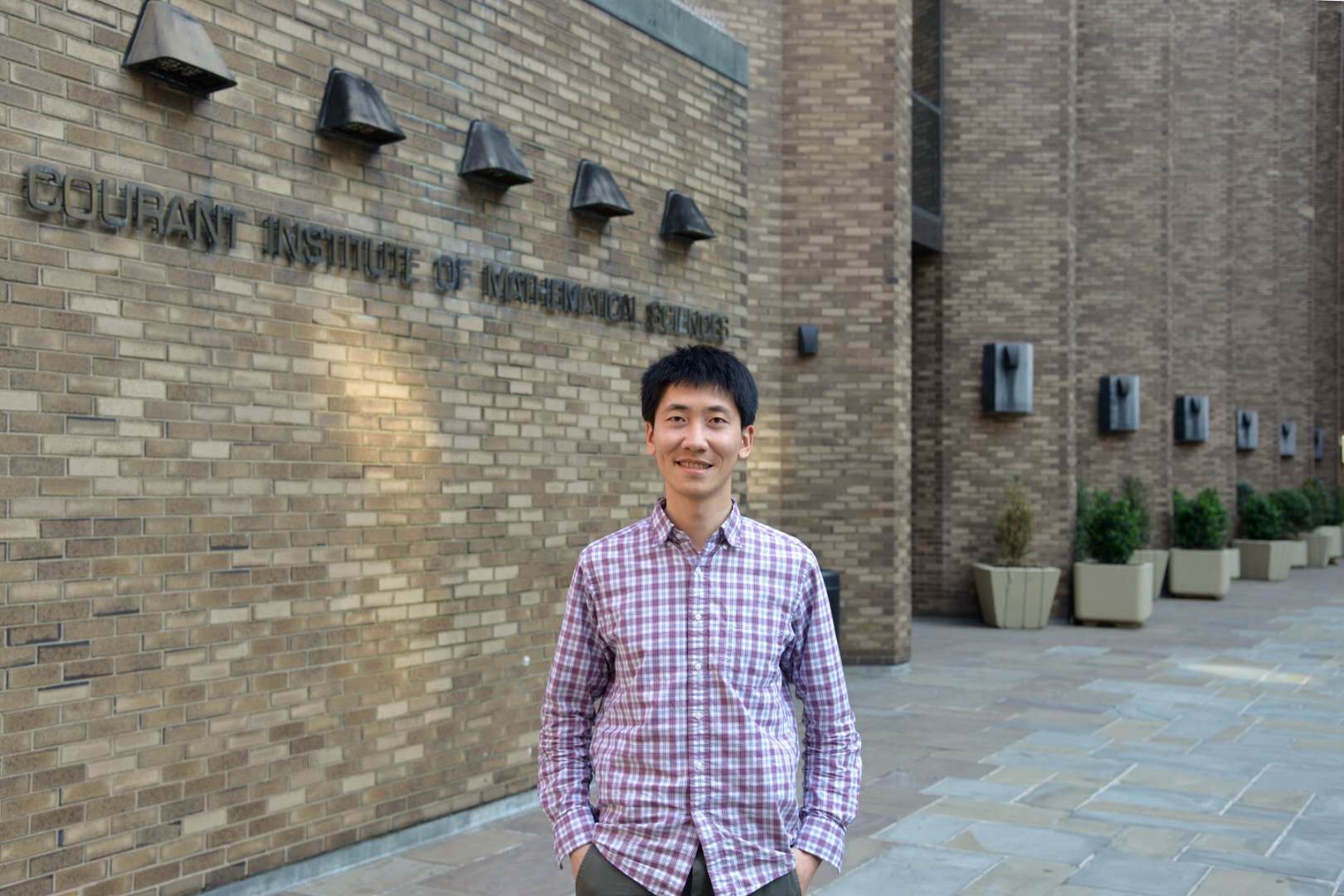
I received my PhD degree from the Courant Institute of Mathematical Sciences (CIMS) and the Center of Atmosphere and Ocean Science (CAOS), New York University (NYU) in May 2016. After that, I was a postdoc research associate at CIMS, NYU from June 2016 to May 2018. My PhD advisor and postdoc mentor were both Dr. Andrew Majda. My undergraduate major was Mechanical Engineering, Fudan University in Shanghai and I received my Master's degree at the School of Mathematical Sciences Fudan University, working with Dr. Jin Cheng, during which time I also visited the Department of Scientific Computing at Florida State University for one year, working with Dr. Max Gunzburger and Dr. Xiaoming Wang.
Research summary.
(Please see my research and publications pages for more details).
My research interests lie in contemporary applied mathematics: modeling complex systems, stochastic methods, machine learning techniques and applications, digital twins, causal inference, numerical algorithms, geophysics, and general data science. Problems with large dimensions, turbulence, and partial information are mainly what I am concerned with. Mathematical and physical problems in uncertainty quantification (UQ), data assimilation, information theory, scientific machine learning, applied stochastic analysis, inverse problems, high-dimensional data analysis, and effective prediction are among my research topics. I am also devoted to proposing efficient and statistically accurate algorithms to alleviate the curse of dimensionality for large-dimensional complex dynamical systems with strong non-Gaussian features. In addition, I'm active in developing both dynamical and stochastic models and use these models to predict real-world phenomena related to atmosphere-ocean science, and other complex systems such as the Madden-Julian Oscillation (MJO), the monsoon, the El Niño Southern Oscillation (ENSO), and the sea ice based on real observational data. My recent work also involves the development of new UQ and stochastic methods for material science and other applications. The mathematical and computational tools developed in my work can have a significant impact on diverse fields, including atmospheric-ocean science, materials science, neuroscience, excitable media, physics, and engineering.
In general, I have a broad research interests in bridging applied mathematics, machine learning and data science, atmosphere and ocean science, and engineering, neural science, biology and others.
Some of my research are highlighted by media: SIAM News, SIAM DSWeb, EoS, Springer Nature Research Communities, Miragenews, The National, etc.
Scientific Communication & Outreach.
(Please see my outreach page for more details).
1. Video Series: Applied Mathematics Toolkit: Modeling • Data • Algorithms
Over the years, I have noticed a recurring challenge in teaching applied mathematics: many powerful ideas are often introduced through examples that are already too complicated for first exposure. While finishing our book Applied Mathematics Toolkit: Modeling • Data • Algorithms for Scientists and Engineers, Charlotte Moser and I began developing a complementary short-video series built around a simple principle: one concept • one example. Each 5–10 minute video focuses on a single idea and uses deliberately simple examples to build intuition, support early learning, and provide efficient review. So far, we have completed two modules (Statistical Toolkit and Machine Learning Toolkit), with three more in progress (Applied Analysis Toolkit, Dynamical Systems Toolkit, and Stochastic Toolkit). The series is intended for upper-level undergraduates, early graduate students, and researchers seeking a clear conceptual entry point before moving to more technical treatments. The videos are presented by Charlotte Moser, and are shared openly in the hope that they may be useful for learning, teaching, or quick conceptual review. The videos are freely available on her YouTube channel and RedNote. We hope this format offers a small but meaningful contribution toward making applied mathematics more accessible, modular, and reusable across disciplines.
Interactive companions to the series are available through MPE Studio, where many of the concepts introduced in the videos can be explored through simple browser-based experiments and visualizations.
2. Video Series: Applied Mathematics in Geosciences
We are excited to launch a new public-facing video series on applied mathematics in modern geosciences (YouTube link here), inspired by our recent perspective article on the evolving role of applied mathematics in Earth system science.
Modern Earth and environmental systems involve major scientific challenges, including multiscale interactions, uncertainty, limited observations, extreme events, and changing climate conditions. Addressing these problems increasingly requires close collaboration between applied mathematics, statistics, data science, and geosciences. This series was created to help make these emerging ideas and interdisciplinary connections more accessible to a broader audience.
Through short 5–12 minute presentations, the series explores topics such as modeling, prediction, uncertainty quantification, dynamical systems, data assimilation, machine learning, and the limits of predictability in Earth systems. Designed for students, early-career researchers, and newcomers to the field, the series emphasizes both the role of mathematics in understanding the Earth system and the reciprocal influence of geoscience on modern mathematical development.
Developed collaboratively by myself and Charlotte Moser, the series combines mathematical insight with accessible scientific storytelling for a broad audience, with Charlotte Moser serving as the presenter.
We are grateful to all collaborators and colleagues who contributed through discussions, feedback, and encouragement. We would especially like to thank Reza Malek-Madani for his thoughtful discussions and valuable feedback on this video series.
The series is also connected to MPE Studio. The videos and the Studio are intended to provide complementary ways to encounter the same ideas through explanation, visualization, and hands-on exploration.
3. Tutorial Papers
I have a paper "Taming Uncertainty in a Complex World: The Rise of Uncertainty Quantification — A Tutorial for Beginners" at the Notices of the AMS with Stephen Wiggins and Marios Andreou. It is a short paper with many very simple examples to introduce UQ to beginners! Codes in Matlab and Python are available.
Openings:
I am always looking for highly motivated PhD students to work with me. If you have been admitted to our Math PhD program and are interested in my work (even if you start as a pure math student), please feel free to contact me.
(Last updated 08/17/2026)
